
GEO in 2026: how to win traffic when AI answers instead of search
What GEO (Generative Engine Optimization) is, and how to keep winning traffic and customers as AI — not the classic search results page — increasingly delivers the answer.

TL;DR
After 2022 and the arrival of mass-market LLMs, organic traffic stopped being a single channel. More and more users get a ready answer right inside the AI, without ever opening the results page or clicking through to a site. GEO (Generative Engine Optimization) is optimization for generative engines: the work of getting your brand into the answers of ChatGPT, Perplexity, Google AI Overviews and Gemini.
By query volume, classic search still dominates, but generative engines are growing faster than search ever did. The good news: there's less AI traffic for now, but it converts on average 4.4x better than ordinary organic. GEO compounds over time and works for the long game rather than for a quick win, which is exactly why you should start now.
What GEO is, and why the shift is happening now
Familiar organic traffic changed after 2022, when the first widely available LLMs appeared. Users increasingly get ready answers straight from AI and reach the classic results page less often. Traditional search still dominates by volume, but the picture shifts year over year.
The scale is easiest to grasp through a comparison: search leads by volume, while generative engines win on the pace of audience growth.
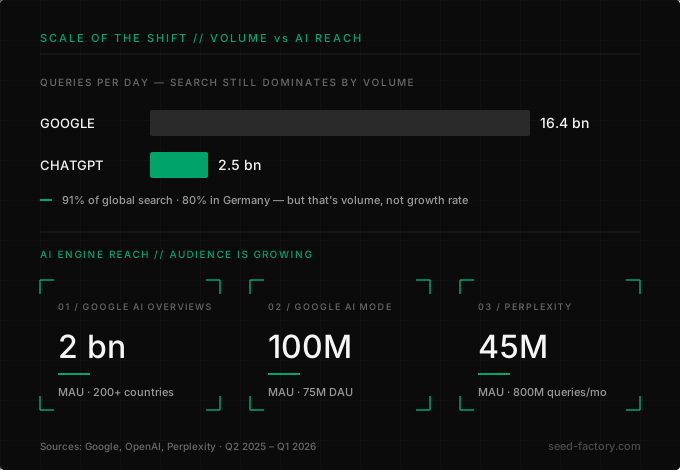
The picture is twofold. By number of queries search is still ahead, but the audience of generative engines is growing at a pace traditional search never showed. We're entering a period where traffic and customers split across two channels at once, and you need to optimize for both.
The behavioral shift
Most US users already treat AI as a search engine. According to a Searcherries survey (1,090 people, February 2026), 54% use AI search every day, and another 24% several times a week — nearly 78% who use it regularly.
Scale matters here too. AI search now accounts for about 17% of all digital query volume (First Page Sage). That's a meaningful share, but it doesn't mean classic SEO is dead: this isn't replacing the old channel, it's adding a new one. 36% of generative-AI users say they've already swapped part of their usual queries for it, and in software development around 30% of search already goes to ChatGPT.
There's a structural risk, too. Organic traffic depends heavily on the search giants: if Google reshapes its results tomorrow, it can drop to almost zero. In late May 2026 Google built a non-dismissible AI assistant into search, after which DuckDuckGo installs jumped roughly 30%. But in Germany only about 2% of the audience uses private search engines, so Google will keep changing its algorithms gradually. That buys some time, but the shift will happen sooner or later.
Traffic changes: the zero-click paradox
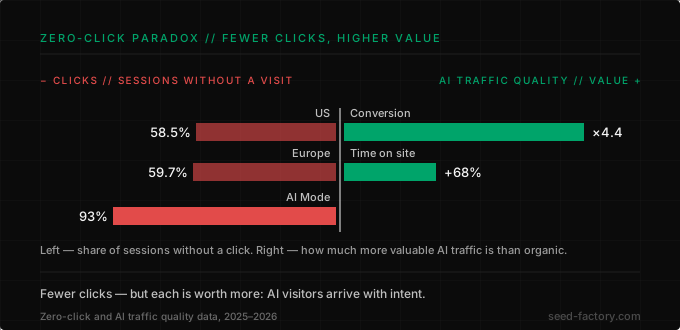
SEO's biggest headache is zero-click. Almost 60% of search sessions in the US and Europe end without a single click through to an external site, and where AI Mode is on, 93% of sessions go without a click.
But there's a flip side: traffic quality changes. AI visitors convert several times better than ordinary organic and spend noticeably more time on the site. The paradox is that AI search kills click counts but raises their value. Someone who clicked a link inside an AI answer already has context, has compared options and arrives with concrete intent. That's a fundamentally different visitor from the one who randomly opened the first link in Google.
Technical accessibility for search and LLM bots
Speed and server-side rendering (SSR/SSG) are critical. If content loads on the client via JavaScript, a bot risks seeing an empty page. To prevent that, a site has service files that tell bots how to handle its content.
robots.txt is mandatory for search bots: it spells out what can be crawled and what's better ignored. Make sure the AI bots GPTBot, OAI-SearchBot, PerplexityBot, ClaudeBot, CCBot and others aren't blocked there.
It's also worth placing an llms.txt file at the root of your site. It's a new and still unofficial format, a kind of robots.txt for the LLM era: it gives AI structured information about the site and a description of your expertise.
Example llms.txt structure
# Seed Factory - development and IT support
Seed Factory specializes in full-stack development (React, Node.js),
DevOps and digital marketing for European startups and SMBs.

## Key pages
- /services - services and technologies
- /cases - client cases with results
- /blog - articles on web development and GEO
- /contact - contacts and the inquiry form
There are two formats: a short llms.txt for quick indexing and an extended llms-full.txt with the full content of key pages. The extended version is more useful: it gives models full structured context, which makes it easier for AI to extract and use the information.
Content structure and Schema
LLMs extract information more effectively from predictable structures: H2 and H3 headings that answer the question directly; the key fact at the start of a paragraph rather than the end; tables for comparisons; numbered lists for processes.
Schema markup is structured data that gives AI machine-readable information and helps it grasp not just the text but its meaning. Prioritize the FAQPage, HowTo, Article, Organization and Product types: they map neatly onto the question-and-answer format the model generates.
Authority: E-E-A-T
The E-E-A-T concept (Experience, Expertise, Authoritativeness, Trustworthiness) comes from Google's Quality Rater Guidelines and is used to assess content quality and trust.
During training and RAG retrieval, models prioritize sources that demonstrate real experience: concrete numbers, cases, named authors. Not because the model "knows" about E-E-A-T, but because such content is more often tied to useful answers in the training data. So working on a site's authority directly affects GEO visibility.
The data backs this up. Content that relies on statistics, quotes and source citations gets 30–40% higher visibility in AI answers: in the original GEO study (Princeton, Georgia Tech, Allen AI, IIT Delhi, KDD 2024) adding sources gave +40%, statistics +37%, quotes +22%, while keyword stuffing brought just +3%. Freshness is critical too: per Ahrefs data AI-cited content is on average 25.7% fresher than ordinary organic, and material under 30 days old gets roughly 3.2x more citations.
Original data and research
Models are trained to prioritize RAG (Retrieval-Augmented Generation), so when retrieving information they lean on the most accurate, verifiable and specific sources. That's exactly why unique data, original research and first-party statistics are especially valuable to AI: such content is hard to find or reproduce elsewhere.
Platform specifics
A GEO strategy can't be identical for every engine, because each leans on its own primary source:
- Perplexity prioritizes freshness and explicit source citation.
- ChatGPT Search requires fast loading and full HTML without JavaScript blockers.
- Microsoft Copilot pulls data from Bing, so Bing Webmaster Tools directly affects visibility.
- Gemini and Google AI Overviews are tightly tied to Google Search.
Most telling of all is where the engines take their citations from. According to Profound (via Cybernews) every platform has its own dominant source.
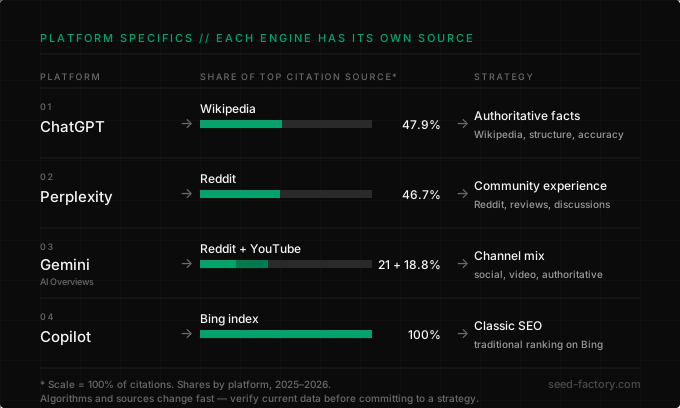
Hence the different tactics. If your audience lives in ChatGPT, work on a presence in Wikipedia and authoritative media. If in Perplexity, bet on recognition in Reddit and topical communities. For Gemini and Google AI Overviews, a top-20 spot in classic Google results remains a must.
Search-query relevance
Not all queries are equally useful; you need a tailored approach. Simply being mentioned as a source in a neural-network answer usually yields a low CTR, often under 1%. But ranking for commercial queries like "Top 3 coffee machine brands" brings both higher CTR and better conversion thanks to the user's clear intent.
GEO singles out a separate category - recommendation-intent queries. They feature words like "best", "top", "recommend", "compare". Here the LLM acts as more than a source of information: it compares options and delivers a ready recommendation.
Factors of brand visibility in AI answers
-
Brand search. Brand-query volume is the strongest known predictor of LLM citation, noticeably stronger than backlinks. The logic is simple: models trained on texts where frequently mentioned brands sit next to relevant queries.
-
Presence on "cited" platforms. To land in a notional Top 3 you need mentions in Reddit discussions (threads like "Best Coffee Machine 2026" or "What CRM do you recommend"), reviews on G2 and Trustpilot, and YouTube coverage.
-
Comparison tables. "Best", "top" and "vs" formats generate the most AI traffic, because they reflect the intent to compare options and decide.
-
Front-loading. First impressions decide: 44.2% of all LLM citations come from the first 30% of a page (Kevin Indig's analysis of 1.2M ChatGPT answers). Put your brand name and its key characteristics right at the start, not in the middle after a long intro.
-
Statistics and quotes as amplifiers. Statistical facts lift AI visibility by 37%, and direct quotes by 22%. Brands that publish original data ("we analyzed N projects and found...") get cited even without a high SEO position.
-
Semantic completeness. This is how fully your material covers the topic. Pages scoring 8.5/10 and above land in AI answers more often. For a "best coffee machines this year" query, for example, the page should answer every question: from price and specs to warranty and comparison with alternatives.
That adds up to a checklist for making it into LLM comparison lists:
- a high position for the branded SEO query;
- mentions in Reddit, YouTube, G2 and other sources in a recommendation context;
- your own pages comparing you with competitors;
- original data and statistics in the content;
- full coverage of the topic on a single page.
What doesn't work in GEO
As in SEO's early years, plenty of myths have already grown around GEO. Let's go through the most common ones.
-
Keywords barely matter. Contrary to expectations, the LLM doesn't scan a page for an exact match to the query. What matters is semantic completeness, not the density of specific words.
-
The link profile carries less weight than in SEO. For ChatGPT and Perplexity, brand mentions in a recommendation context (Reddit, YouTube, industry publications) matter more than the number of backlinks.
-
Paid ads don't affect organic LLM mentions. As of June 2026 you can't buy a spot in an AI answer, unlike Google Ads. That's a fundamental difference.
-
Results come slowly. Training and updating models takes months, so content published today may only start influencing AI answers in six months to a year.
-
One good piece won't fix anything. GEO compounds and depends on a systematic brand presence across different platforms and formats.
What you can do right now
-
Don't expect quick results. Training models takes months and years. GEO works for the long game, not for an instant effect.
-
Check your
robots.txt. Make sureGPTBot,OAI-SearchBot,PerplexityBot,ClaudeBotandAnthropic-aiaren't blocked. If you use a CDN (Cloudflare and others), check that these bots are on the trusted list. -
Register your site in Bing Webmaster Tools and Google Search Console and give them your sitemap. Remember that ChatGPT and Copilot index through Bing.
-
Create an
llms.txtand place it at the root (/llms.txt). It's the fastest and cheapest signal for AI systems: a short plain-text file with a company description and a list of important URLs. -
Add a block of a few sentences to the top of every key page that directly answers its main question. Half of all citations come from the first 30% of the text.
-
Shore up the technical foundation. Slow loading, CSR rendering and closed crawlers block AI traffic entirely.
Need a hand?
Seed Factory audits your site from a GEO perspective, prepares technical recommendations and helps implement them, so you stay visible in classic search and in AI answers alike.
Drop us a line and we'll break down how your site looks to search and AI bots today, and what you can improve as early as this week.