
CAPTCHA in 2026: why the 'checkbox for the sake of a checkbox' is eating your revenue
A breakdown for those who slap a captcha on their lead form out of habit — without counting what it actually costs.

TL;DR
Visible captcha is an expense line disguised as free protection.
It barely works against modern bots — models and solving services crack it faster and cheaper than a human can. What it does work against is your real, live customers, dropping conversion by a few percent (3.2% in the classic Moz test) and up to 40% in the worst retail scenarios. In 2026, visible captcha has a place only in critical, low-traffic actions (password reset, admin panel, sensitive APIs). And even there, invisible alternatives like Cloudflare Turnstile or proof-of-work via Friendly Captcha are preferable.
1. Why captcha no longer protects
Classic captcha has lost to machine vision
Text captchas, pick-the-traffic-light challenges, audio variants — modern OCR and vision models read all of this far better than humans. Humanity has spent millions of hours typing distorted characters and hunting for buses in grids. This undoubtedly helped advance computer vision and the AI we have today. We should probably thank them for the training data.
A study was conducted by UC Irvine, ETH Zürich, Microsoft and Lawrence Livermore (2023). 1,400 real participants against bots — across 120 of the top 200 websites in the world. Bot accuracy landed at 85–100%, with most above 96%, comfortably beating the human range of 50–85%. Bots solve captchas faster than humans in almost every case, except reCAPTCHA, where the human result of 18 seconds is nearly tied with the bot's 17.5 seconds.
Gene Tsudik, one of the study's authors, speaking to New Scientist: "We already knew captchas are widely disliked — we didn't need a study for that. But people don't know whether that colossal global effort spent on solving them every day is worth it." The study's answer: it isn't.
The economics favor the attacker
In the mid-2000s, markets emerged where live humans solve captchas for machines in exchange for a small fee. Today it's a full-fledged CAPTCHA-solving industry — 2Captcha, CapSolver, AntiCaptcha. Solving a captcha on these services costs less than a cent and is available via API. For the attacker, captcha isn't a barrier — it's just another line item.
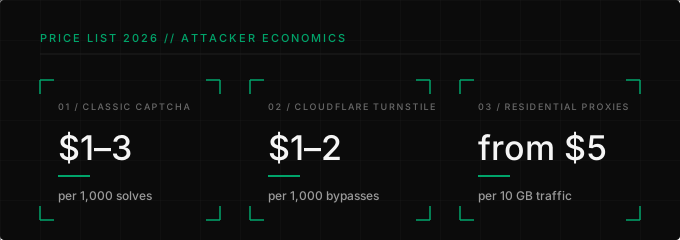
Public 2026 pricing:
- Classic captcha solving — $1–3 per 1,000 tasks
- Cloudflare Turnstile bypass — $1–2 per 1,000 solves
- Residential proxies — from $5 per 10 GB of traffic
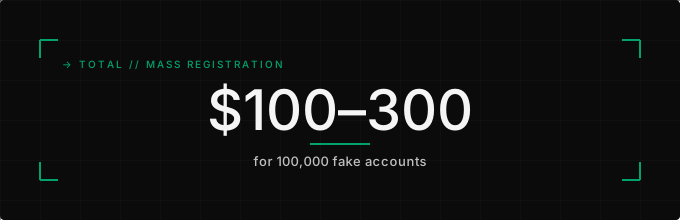
Mass-registering 100,000 fake accounts costs the buyer $100–300. If your business is valuable enough to be a target, captcha isn't going to be what saves you.
Where the failure is most obvious
Against targeted attacks using headless browsers, anti-detect plugins, residential proxies, and integrated CAPTCHA-solving services, defense is almost impossible. Even if you block 95 out of 100 such requests, the remaining 5 sail through without any trouble.
The rise of autonomous AI agents adds another question: how "automated" is an agent if a live user gave it the task? The line between human and bot — the whole premise of captcha — is dissolving in front of us.
This has always been, is, and always will be a sword-and-shield arms race. The more threat you see in every click, the more false positives hit real users — and the more customers you lose.
2. How much captcha costs your business
This is the side of the coin rarely considered when a "checkbox for the sake of a checkbox" gets installed. One of the main reasons for adding captcha is protecting revenue — but only in theory. In practice, captcha often eats more than it protects.
Direct conversion drop
Moz audit (2009). This audit became a classic — one of the first public A/B tests of captcha on a real production form. Without captcha, over 3 months the site saw 2,134 form submissions and 91 spam cases. With captcha — 2,156 submissions, 11 spam entries, but 159 lost conversions. Captcha did cut spam by 88%, but created 159 failed attempts where there had been zero. That "protection" cost roughly 7% of traffic at the very bottom of the funnel. This study is over fifteen years old, but it hasn't lost relevance — the fiction is still a fiction.
Stanford (2010). The first large-scale evaluation of captchas from the human side: over 318,000 captchas from the 13 most widely used image schemes and 8 audio schemes. When three people solved the same image captcha, their answers matched only 71% of the time; for audio captchas, just 31%. An image captcha took 9.8 seconds on average, an audio one 28.4 seconds, and participants gave up on roughly half of the audio tasks. A week of real eBay data (14 million captchas) showed this isn't a lab artifact: about 1.5% of all captchas served ended in a wrong answer. For a business, the takeaway is simple — a captcha filters out not only bots, but also some of the people honestly trying to get through.
Forrester Research. Studies show that 19% of consumers abandon a site when they encounter a captcha — a fifth of users don't even try to solve it.
HUMAN Security (formerly PerimeterX). Their results indicate that 40% of real shoppers abandon a purchase out of frustration with a captcha. This is the biggest and most-cited number in the industry — often called inflated, but even if you halve it, the impact on retail conversion is still catastrophic.
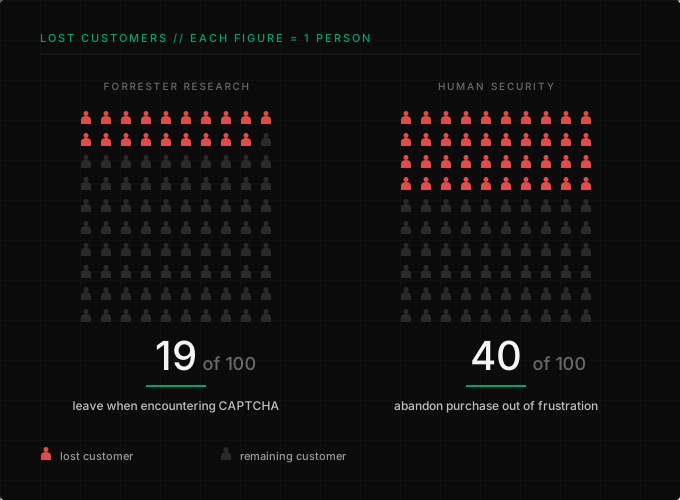
A realistic range runs from 19% (Forrester) to 40% (HUMAN). Where you actually land depends on your segment and where in the funnel the captcha sits.
The invisible price: user time
Cloudflare (2021) ran internal research when launching Cryptographic Attestation of Personhood and found that average captcha solve time is 32 seconds, there are roughly 4.6 billion global internet users, and the average user sees the same captcha every 10 days. In aggregate, humanity burns around 500 person-years per day proving to computers that we're human. Cloudflare publicly announced its intention to eliminate captchas as a class of technology. The figures were criticized, but even the downward-corrected estimates still land in the hundreds of person-years daily. Some of that time is yours. The rest belongs to your customers.
3. The GDPR angle: why reCAPTCHA is a legal risk in Germany
For the German and European market, visible captcha has another dimension that rarely surfaces in public discussion — DSGVO/GDPR compliance.
Google reCAPTCHA sends a user's IP address, cookies, device information, and behavioral data to Google in the US. Post-Schrems II and until the EU-US Data Privacy Framework is fully in force, this qualifies as transferring personal data to a third country and requires:
- Explicit user consent before the script loads (important: before, not after)
- A mention in the Datenschutzerklärung with purpose and legal basis
- A risk assessment (DPIA) for sensitive scenarios
There have been precedents where Datenschutzbehörden and German courts classified thoughtless use of reCAPTCHA as a violation. For now, fines remain the exception rather than the rule — but the risk is real, especially for B2B sites, which regulators and competitors watch more closely.
Despite the constraints, there are privacy-friendly alternatives:
- Friendly Captcha — a German company from Munich, proof-of-work, runs without cookies or tracking, with EU servers. A marketing and legal bonus for a DE audience.
- hCaptcha — processes data in the EU, offers an Enterprise mode without US data transfer.
- Cloudflare Turnstile — doesn't use cookies for the challenge, passes most DSGVO checks when correctly configured.
4. What to replace it with: a decision matrix
The core principle is that the level of protection should match the cost of an error at that specific funnel stage. A landing page and a checkout are not the admin panel, and vice versa.
| Where | What to use | Why | False-rejection risk |
|---|---|---|---|
| Landing-page lead form | Honeypot + rate-limiting | High cost of rejection, low value of spam | Minimal |
| Registration / checkout | Cloudflare Turnstile (invisible) | Minimum friction, blocks mass traffic | Low |
| Password reset, admin | Behavioral captcha + 2FA | Low traffic, high cost of compromise | Acceptable |
| Public APIs | Proof-of-work (Friendly Captcha, mCaptcha) | Privacy-friendly, expensive for botnets | None |
| Payment forms | Behavioral analysis + 3-D Secure | Protection already exists on the acquirer side | Low |
Landing-page lead form
- What to use
- Honeypot + rate-limiting
- Why
- High cost of rejection, low value of spam
- False-rejection risk
- Minimal
Registration / checkout
- What to use
- Cloudflare Turnstile (invisible)
- Why
- Minimum friction, blocks mass traffic
- False-rejection risk
- Low
Password reset, admin
- What to use
- Behavioral captcha + 2FA
- Why
- Low traffic, high cost of compromise
- False-rejection risk
- Acceptable
Public APIs
- What to use
- Proof-of-work (Friendly Captcha, mCaptcha)
- Why
- Privacy-friendly, expensive for botnets
- False-rejection risk
- None
Payment forms
- What to use
- Behavioral analysis + 3-D Secure
- Why
- Protection already exists on the acquirer side
- False-rejection risk
- Low
What actually works in 2026
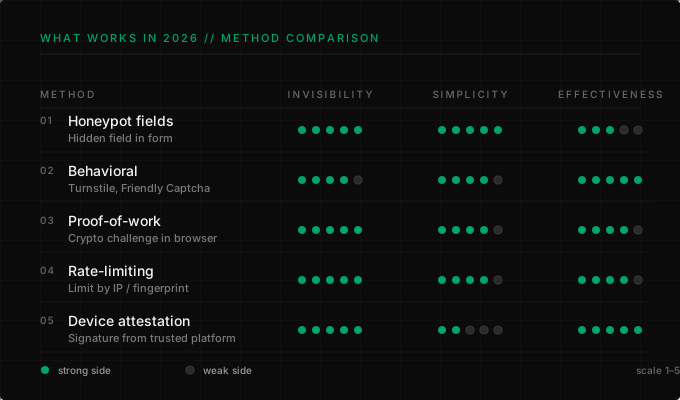
Honeypot fields. A hidden field invisible to humans but filled in by primitive bots. A filled field triggers rejection. It's not a captcha in the traditional sense, but for landing pages and contact forms it blocks 80% of spam without a single user click.
Invisible / behavioral. Options like Cloudflare Turnstile, hCaptcha Invisible, Friendly Captcha analyze mouse movements, timings, device fingerprint, and IP reputation. Based on that data, they issue a "humanness" score. In over 95% of cases the user doesn't even notice they've passed a captcha. This is today's standard.
Proof-of-work. The client browser spends a few seconds solving a cryptographic task. Humans don't notice it; mass attacks become expensive in CPU terms. On top of that, the system is privacy-friendly, no tracking.
Infrastructure-level rate-limiting. Surprisingly, this is the most underrated measure. Rate-limiting per IP / fingerprint cuts 90% of automated noise before it ever reaches the form.
Cryptographic device attestation. The site receives a signature from a trusted platform confirming the request comes from a real device owned by a real user. No puzzle at all. This is a future that's already here — for now, mostly relevant in the Apple ecosystem.
5. Calculator: how much captcha is costing you
There's a simple formula to estimate direct revenue loss from visible captcha on a lead form or checkout:
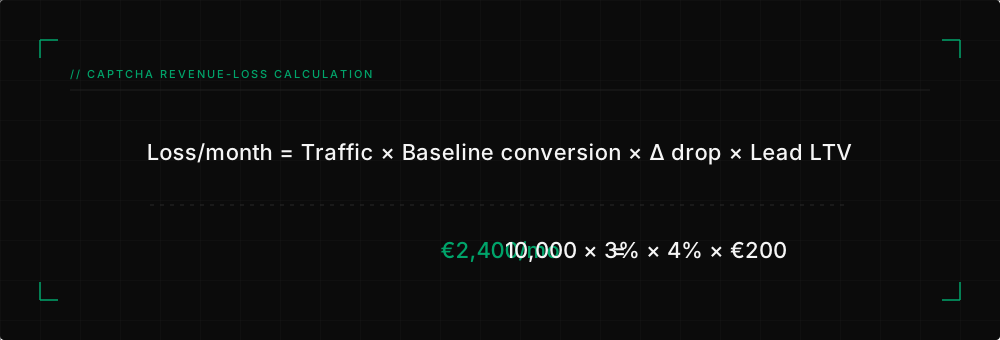
Plug in your numbers — the calculator does the math. Defaults mirror a typical SaaS landing page:
Loss per month
€2,400
Loss per year
€28,800
If the result is greater than zero, you already have a business case for replacing visible captcha with an invisible alternative.
6. What to do Monday morning
-
Find every form on your site that currently has a visible captcha (reCAPTCHA v2, hCaptcha checkbox, any "pick the buses" thing, and so on).
-
Determine the cost of error for each form. For leads — replace with honeypot + rate-limiting; for checkout — Turnstile; for admin, leave it but check whether you can switch to invisible mode.
-
Check your Datenschutzerklärung if you're in Germany or targeting the DE market: is reCAPTCHA mentioned, and are you getting consent before the script loads?
-
Run the formula from Section 5 on your own data. Write the number down — that's the budget you're losing every month for no reason.
-
Schedule an A/B test: half the traffic on the current captcha, half on the new solution. Key metrics: conversion, bounce rate, spam share in leads. After 2–4 weeks you can decide based on data instead of gut feel.
Need help?
Seed Factory runs a full audit of forms and conversion points, quantifies actual losses from existing protective mechanisms, and rolls out solutions that effectively block bots without scaring off real customers. All solutions are DSGVO-compliant and tailored for the German and European market.
Get in touch if you want to know what your current captcha is costing you — and, more importantly, how to replace it without losing protection.